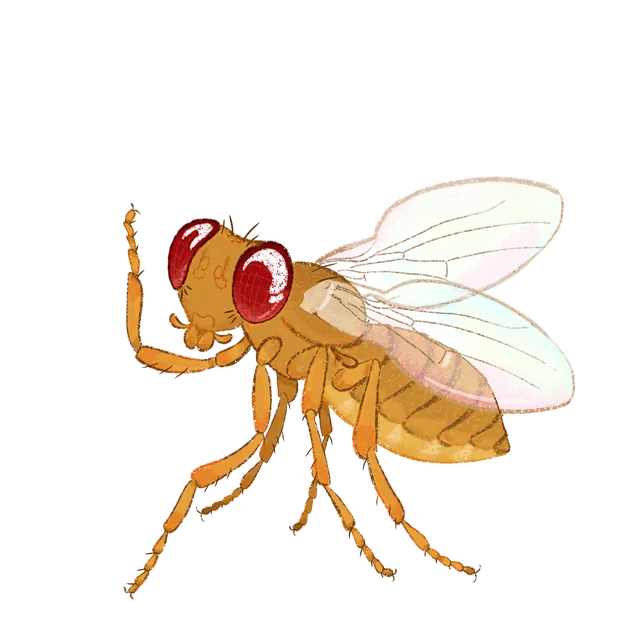
Predict, test and compare. Build vocabulary about life cycles, inheritance and experiments.
🎤 Interactive simulationSuggested ages 7–12
Drosie’s First Scientific Conference
Investigate a simulated fruit fly climbing experiment or your own project, write an abstract, build a poster and present at a pretend conference with fictional scientists.
Learning objectives
- Tell a question from a hypothesis and a prediction
- Read graphs honestly and separate observations from interpretations
- Communicate findings, including limitations
A simulation: the fruit fly data are made up for learning. Teacher and parent guide included.
🎮 Interactive gameSuggested ages 5–11
Fruit Fly Life Cycle Game
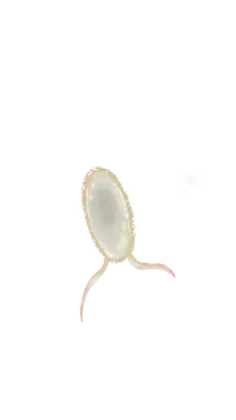
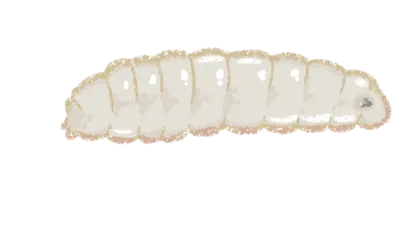
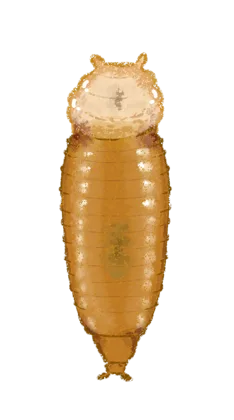
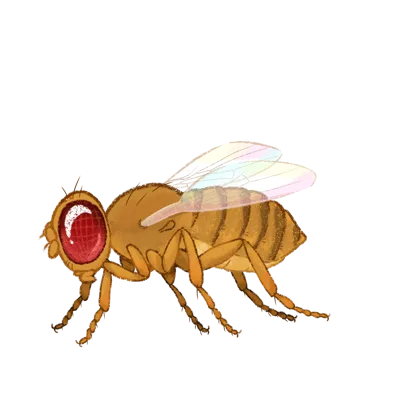
First explore how a fruit fly develops, from egg to adult, then test what you learned in the game. Includes reading-support and accessibility tools and written explanations for every step.
Learning objectives
- Sequence egg, larva, pupa and adult
- Describe complete metamorphosis in simple words
Accessibility panel: larger text, high contrast, reduced motion, easy reading, calm focus.
Open Fruit Fly Life Cycle Game↗🧪 Virtual experimentSuggested ages 5–11
Grow Your Own Fruit Fly (virtual lab)
Prepare food, set up an incubator and watch six stages of development in an accelerated classroom simulation, with Drosie as a scripted science guide.
Learning objectives
- Follow a life cycle from egg to adult
- Practise predicting, observing and explaining
A simulation, not live animals. At about 25°C real flies take roughly 9–10 days from egg to adult.
Open Grow Your Own Fruit Fly (virtual lab)↗🧪 Virtual experimentSuggested ages 5–11
Drosie's Climbing Challenge
Predict how many of ten virtual flies will climb above the line, run three trials and compare the results. Introduces the climbing assay scientists use.
Learning objectives
- Make a prediction before testing
- Compare repeated trials
- Meet the term negative geotaxis
Results are randomly generated for learning, not real measurements.
Open Drosie's Climbing Challenge↗🎮 Interactive gameSuggested ages 5–12
Drosie Genetics Lab: Little and Junior levels
Choose parent flies from a stock center, breed them, look at the offspring under a microscope and predict results with Punnett squares. Little Geneticist is for ages 5–8 and Junior for 9–12.
Learning objectives
- Observe inherited traits such as eye colour and wing shape
- Predict offspring with a Punnett square
- Keep a research notebook
No accounts. Optional progress stays in your own browser and can be reset.
Open Drosie Genetics Lab: Little and Junior levels↗🖨 Printable worksheetSuggested ages 5–14
Genetics Lab printable worksheets
Printable worksheets with optional answer keys. Worksheet 1 is for ages 5–8, Worksheet 2 for ages 9–12 and Worksheet 3 for ages 13–17. Worksheets 4 and above are for older students.
Learning objectives
- Record observations and predictions on paper
- Practise reading genetic data
Use your browser's Print or Save as PDF.
Open Genetics Lab printable worksheets↗📖 Reading resourceSuggested ages 9–14
Drosie's Discovery Library
Short, plain-language summaries of real fruit fly research, grouped by topic (brain and behaviour, genetics, aging) for curious families and classrooms.
Learning objectives
- Read about how real research uses fruit flies
- Connect a discovery to a question scientists asked
Each entry is labelled with its research year.
Open Drosie's Discovery Library↗🖨 Printable worksheetSuggested ages 5–8
Lesson Activity Sheets 1–7
Seven printable student activity sheets, each with a short teacher mini-guide, matching the seven lessons of the Drosie storybook. Download all together or choose a single lesson below.
Learning objectives
- Follow the seven lesson themes from the Lessons section of the homepage
ZIP of seven PDFs. Individual PDFs are linked in the list below.
Download Lesson Activity Sheets 1–7↓